
STIA Faculty Spotlight: Meet Dr. Zack Garvin, STIA’s New Assistant Professor of the Practice and Space Concentration Chair
Avery Wallace | October 14, 2026
For astrobiologist Dr. Zack Garvin, studying space means working across many disciplines. His research draws on microbiology, chemistry, geology, and planetary science to investigate the possibility of life beyond Earth. As STIA’s new space concentration chair, Dr. Garvin brings that same interdisciplinary approach to education: preparing students for a future where scientific discovery, international cooperation, commerce, and security increasingly intersect.
Garvin spent the past two years at Georgetown as a postdoctoral fellow within STIA, conducting research in the Johnson Biosignatures Lab, led by Professor Sarah Stewart Johnson. Alongside his research, he took on teaching and mentoring responsibilities, including developing STIA 4005: Foundations of Space Studies. Working with students helped inspire his interest in shaping the program’s future.
“It has been an incredibly rewarding experience to work with Georgetown’s undergraduate and graduate students, who are so passionate about space and the many lenses through which it can be studied and applied,” Garvin said.
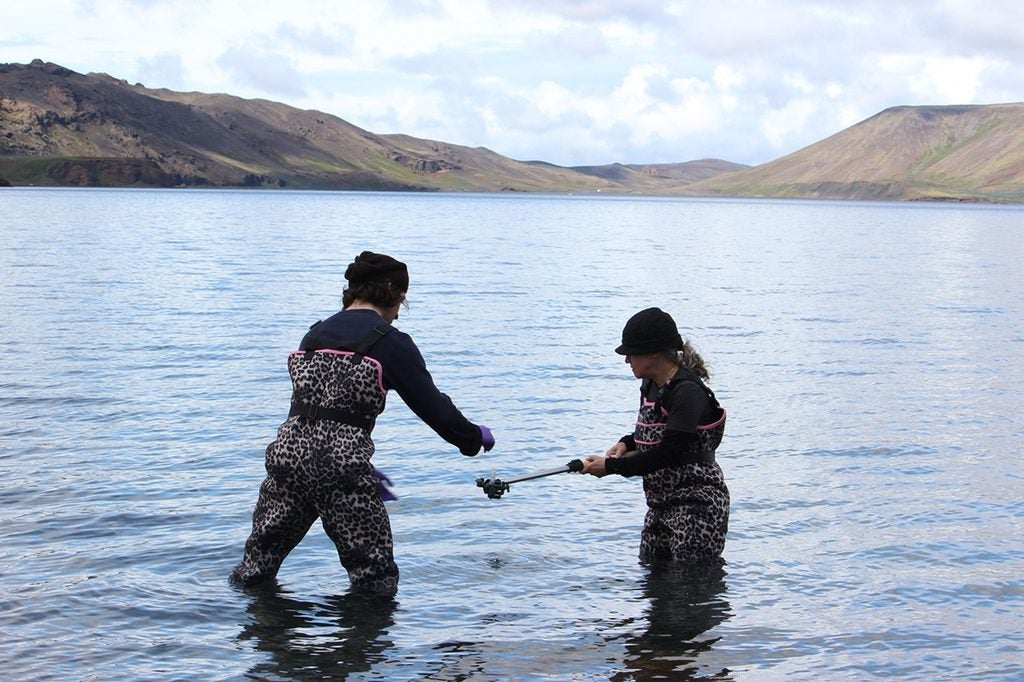
Garvin collects samples on a NASA field campaign in Iceland.
In his new role as professor and concentration chair, Garvin hopes to expand the number of diverse course offerings, create more student opportunities for engagement, and establish a well-defined curriculum so that students have a strong sense of the path ahead of them when choosing the STIA space concentration. “I view the most important aspect of this role as building a program that produces well-rounded, ‘space-literate’ graduates,” Garvin said.
For Garvin, that literacy means developing real expertise while understanding how different dimensions of space connect. By graduating with a STIA space concentration, students should be able to discuss the latest NASA mission priorities with scientists, debate U.S.-China space relations with policymakers, and assess the security implications of emerging satellite technology.
The STIA program’s growing curriculum reflects this range, with new course offerings covering topics such as Orbital Dynamics and Cislunar Governance. The space concentration’s gateway course, Foundations of Space Studies, introduces students to different space disciplines through three modules taught by experts in their respective fields. The undergraduate space concentration and graduate certificate provide pathways for students to engage with space studies as part of their degrees, and an undergraduate minor and a master’s program are currently in development to further expand student access to space studies at Georgetown.
Beyond the classroom, opportunities for students to participate in research and hands-on learning experiences continue to grow. Two Georgetown summer internship programs have been established at Lawrence Livermore National Lab and NASA Goddard Space Flight Center, where students can pursue independent projects under professional guidance. Students can learn about more space courses, programs, and opportunities at spacestudies.georgetown.edu.
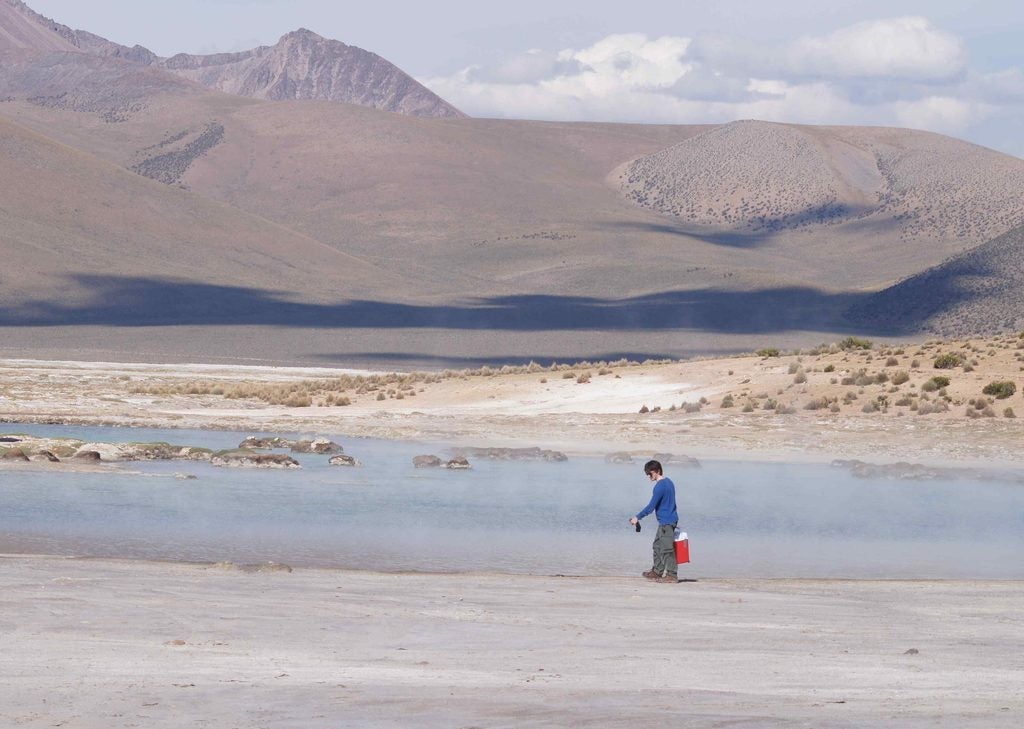
Garvin studies extreme environments in the Atacama Desert in Chile.
Garvin’s own work reflects how scientific questions can connect to these broader opportunities. His research has taken him from South African gold mines to the Atacama Desert and the Chilean Andes, where he studies microbial communities and the chemical signatures they leave behind. These extreme environments offer clues about the life scientists might expect to find on other worlds.
Garvin is also preparing for the European Space Agency (ESA)’s ExoMars Rosalind Franklin Rover mission, set to launch in late 2028, as a member of the Mars Organic Molecule Analyzer (MOMA) science team. At Georgetown, he has modified a commercial mass spectrometer to help the MOMA team develop strategies for operating the instrument and interpreting data from Mars. Garvin has also been involved in a NASA field campaign to Iceland, exploring how evolving hydrothermal systems shape the mineralogy and associated microbiology of their environments.
“Mission science is inherently influenced by policy and international affairs,” Dr. Garvin said. Such projects depend on sustained cooperation across governments, public and private institutions, and leaders willing to support long-term scientific goals.
That relationship is central to Dr. Garvin’s vision for STIA. Understanding the physics of orbital debris, for example, can help students better evaluate a treaty provision or a commercial licensing framework intended to address it. Georgetown’s policy expertise and Washington D.C. location offer opportunities to connect scientific understanding with internships, applied research and leading experts across the space sector.
“Mission science is inherently influenced by policy and international affairs.”
Zack Garvin
As the program grows, Dr. Garvin hopes students will recognize both the range of possibilities within space studies and the value of its interdisciplinary nature.
“I want students to recognize that answering the big questions in space often requires pulling from many different fields,” Dr. Garvin said.