
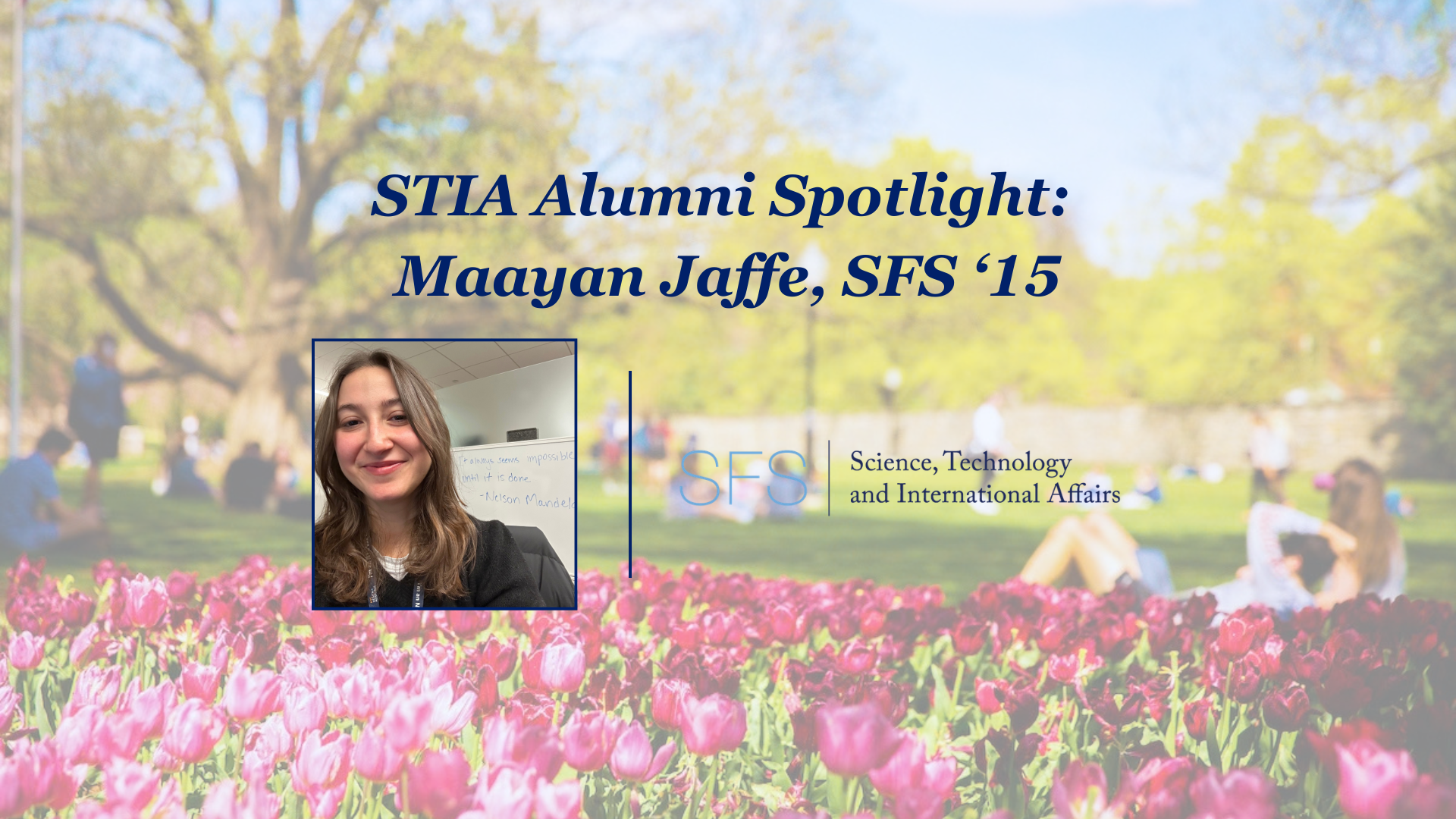
Adaptability and Public Health: Maayan Jaffe (SFS ’15) on Resilience, Evolution, and Lifelong Learning
Returning to a City She Loves
When Maayan Jaffe (SFS ‘15) graduated, she didn’t immediately plan on working for New York City Health + Hospitals. And certainly not during the administration of her old high school classmate, now-Mayor Zohran Mamdani. But for the last six years, she has found herself working in the NYC government. Most of this time has involved developing and managing public health programs that respond to emergent challenges and promote resilience among New Yorkers.
Maayan grew up in New York City and moved to Washington, D.C. to study Science, Technology and International Affairs (STIA) in the School of Foreign Service at Georgetown University. Her interest in public health led her to spend a semester abroad in Brazil. While abroad, Maayan learned about the concept of jeitinho–a cultural concept that is a clever, flexible, or improvised way to connect with people, get creative, and get things done. She explained, “Jeitinho is often referred to as a savvy way of navigating bureaucracy. In my life and in my career I really ran with that. I think bureaucracy is powerful and if you know how to maneuver it ethically and for the public good, you can do incredible things for people.”
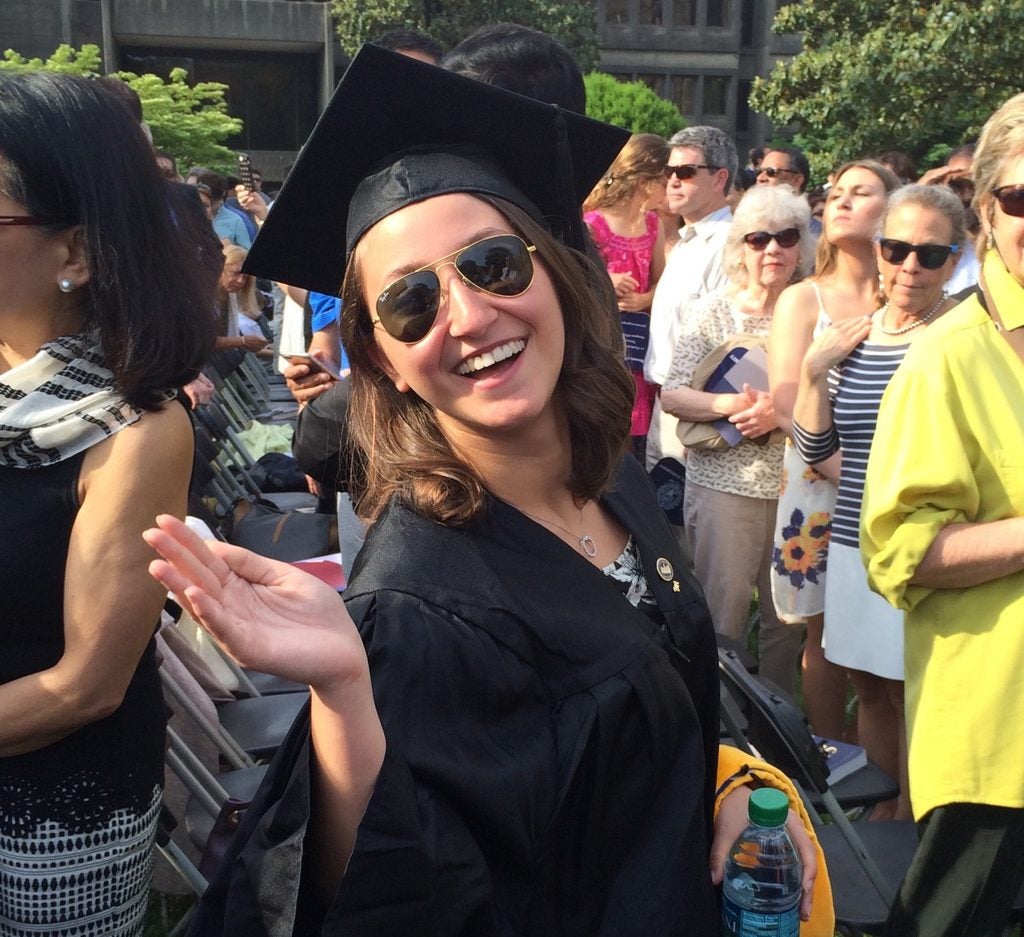
Maayan Jaffe at her SFS graduation in 2015.
From a Job in the Private Sector to a Career in Public Service
Like many students in the global health concentration, Maayan looked for work in the private sector after graduating. Maayan’s first job in D.C. was at a global mobile health startup focused on using mobile phones to capture data in clinical research. In Maayan’s words, “Now it’s so obvious that we need to capture data digitally in clinical research, but at the time it was cutting edge.” Maayan’s career has always been about adaptation. For Maayan, the ability to change in response to an ever-evolving health landscape is imperative to staying relevant. She believed that her first job would equip her with the skills in project management that would enable her to pivot to her passion for public service long-term.
Eventually, Maayan returned to school to deepen her technical expertise. She received her Master’s in Public Health (MPH) at the Sociomedical Sciences program in Columbia University’s Mailman School of Public Health, with a focus on the social determinants of health and sexual and reproductive health. She worked on a project that focused on intersections of periods, public restrooms and people in NYC highlighting her passion about housing and women’s health. In spring 2020, facing a rapidly evolving pandemic job market, she decided to do some freelance consulting for the WHO, where she coauthored a paper on power and mistreatment of women in maternity care.
COVID as a “Game-Changer”
When job opportunities started popping up in the pandemic response, Maayan relied on her adaptability and pivoted even though she wasn’t expecting to work in infectious disease. Suddenly, everyone was talking about health disparities and their drivers. “It was a terrifying time and also a validating time to have chosen public health as a career.” Starting her project management position doing central operations for the NYC COVID Response, she immediately knew she was in the right place addressing health disparities in her hometown. She said, “From the infrastructure of the COVID response, my job has continued to evolve. Some of the knowledge we all gained during COVID helped future emergency responses that we faced as a city.”
“[The COVID pandemic] was a terrifying time and also a validating time to have chosen public health as a career.”
Maayan Jaffe
After COVID, Maayan pivoted again to work on the asylum seeker response, which catapulted her into a career that intersects with homelessness and affordable housing. One project was a temporary housing program for people suffering from severe mental illness that offers holistic care on-site.
The WARM/COOL Programs
Recently, Maayan pivoted again. This time she shifted to work on the WARM and COOL programs, which combine her previous expertise on homelessness in NYC with a climate-focused response. She said, “We had a really severe winter in NYC this year, so we started a program that brings mobile units directly to people experiencing street homelessness. These mobile units are vans filled with a team of a clinician, a driver, and an administrator working together. New Yorkers were offered a clinical check, a meal, a friendly face, and a transport to a safe location of their choosing.” She explained how this work continues throughout the year: “In the summer, we decided to try the program on the street and in homes for people who need to cool down. Lots of heat related deaths also happen indoors in the summer, particularly among older adults or people with complex health needs who don’t have AC and can’t easily leave. I hope this type of mobile, adaptive care delivery is something that continues in a variety of climate emergencies long term.”
Given her global health background, Maayan is eager to learn from and share city-to-city knowledge with people in other municipalities both in and outside of the US. “I’d like to think about this as a tool for resilience for other climate disasters, meeting people where they’re at in an adaptable, non-coercive way.”
A STIA Degree’s Support for a Career in Public Service
Maayan is grateful for her interdepartmental education at the School of Foreign Service because it trained her for intergovernmental or interagency work. She said, “Georgetown really prepared me for this interstitial stuff, hopping between not just different types of programs but also different types of work. In the midst of my day, I move between conversations that are more financial to others that are in the public health data and to those that are more operations oriented. Then I might move into a policy conversation. It’s because of the interdepartmental cross-pollination that happens at a place like Georgetown that I’ve been able to build a unique career that meets my broad appetite for being a generalist in the most exciting possible way.”
Advice for Future STIA students
Maayan’s career teaches us that in a field that is constantly changing, you need to stay adaptable and receptive to change.
“You just need to stay adaptable and intellectually curious!”
Maayan Jaffe
“Most of the work I did immediately after college is now done with AI,” she explained. “These opportunities shift so quickly. After college, becoming a project manager was a huge opportunity for me to get skills that I could use across sectors.” Even as technology changes so swiftly, there will always be an essential need for the human skills of communicating across stakeholders, managing programs and partnerships, and using your values to guide the work.
“Remember, you just need to stay adaptable and intellectually curious!” she said. “There is always something interesting to work on, but it might look different than what you imagined when you graduated from Georgetown. It also feels truly satisfying professionally and morally to be able to respond to whatever emergent needs come next.”