
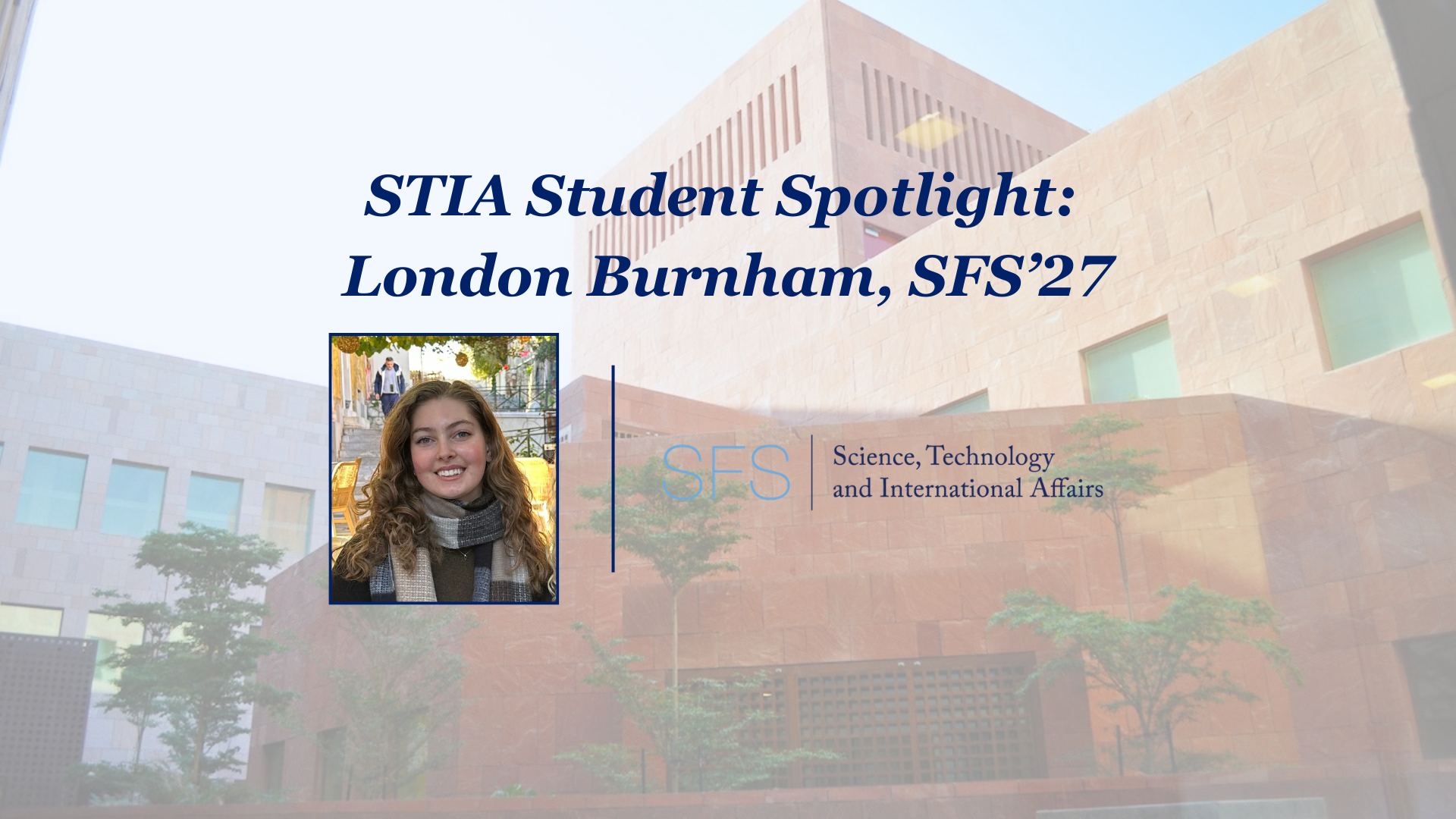
From Psychology to Peacebuilding: London Burnham (SFS’27) Builds Her Own Path Through STIA
Avery Wallace| October 2, 2026
When London Burnham (SFS’27) arrived at Georgetown University as a College of Arts and Sciences student, she expected to major in psychology and eventually pursue clinical psychology. She was fascinated by why people make personal decisions that can seem irrational, but as she explored international affairs, she began wondering how those same questions could be applied on a larger scale.
“I came into the school having a passion for psych and neuro,” she said. “I was trying to figure out how I could apply it to make a big impact.”
After transferring into the School of Foreign Service, Burnham originally considered majoring in Culture and Politics. However, she soon realized she wanted to incorporate the biological and neuroscientific foundations of human behavior into her studies. That search eventually led her to the STIA major and to the idea of designing a concentration of her own: cognitive neuroscience.
“I wanted to do some sort of mix of international affairs and psychology and neuroscience,” she said. The flexibility to create a custom concentration was a major reason she chose STIA.
With guidance from STIA faculty and Dean Anna Steinhelper, Burnham developed a proposal explaining how psychology and neuroscience could contribute to the study of international affairs in a way that the existing STIA concentrations could not fully capture. She then selected courses across disciplines to build the concentration herself. During this process, conflict resolution emerged as the central concept that could bring psychology, neuroscience, and international affairs together.
Burnham became particularly interested in the psychological forces that can shape conflict between groups, including bias, group identity, and historical grievances, as well as how those forces might affect escalation, cooperation, and reconciliation. That interest took on new significance during her semester at Georgetown University in Qatar (GU-Q). There, she had the opportunity to study negotiation with Diana Buttu, a Palestinian lawyer and former legal advisor to the Palestinian negotiating team, who teaches negotiation and conflict at GU-Q. During her semester abroad, the Israel-Iran war began, making questions of conflict, negotiation and mediation an immediate part of the environment in which she was studying.

London Burnham with friends during her semester abroad at GU-Q.
“I think [my experience at GU-Q] was the moment where I was like, okay, I think you can do some really great work here, using psych and neuro to resolve conflict,” Burnham said.
When she returned to the Hilltop, Burnham encountered another perspective on conflict resolution through a course with Ambassador Dennis Ross, Georgetown’s Dermont Family Distinguished Professor of the Practice who spent more than a decade working on U.S. involvement in the Middle East peace process, including the 1995 Interim Agreement, the 1997 Hebron accord, and the 1994 Israel-Jordan peace treaty. Moving from Professor Buttu’s experience on the Palestinian negotiating team to Ambassador Ross’s experience in U.S.-led diplomacy in the same region gave Burnham the opportunity to explore negotiation through different professional and political perspectives. Together, these experiences helped solidify the direction of her self-designed concentration.
Currently, Burnham is continuing to explore the intersection between neuroscience and international affairs with her thesis project on developing intervention for conflict resolution. She is also working at the Georgetown Laboratory for Relational Cognition, where she is gaining experience with neuroscience research alongside her international affairs coursework.
“There are a lot of problems in the world you can’t solve by just studying one field.”
London Burnham
For Burnham, an interdisciplinary approach is essential to understanding complex global problems. “There are a lot of problems in the world you can’t solve by just studying one field,” she said. “Even just understanding how people make decisions, and how their motivation works will help you understand why conflicts break out.”
After Georgetown, Burnham hopes to continue her studies at graduate school and eventually apply that research to conflict resolution and negotiation through government, NGOs, or international institutions.
To students whose interests do not fit neatly within a traditional area of study, Burnham says: “Whatever you love studying and whatever you love doing, you can always find a way to apply that to the world and help people.”