
The 2026 Bioeconomy Workshop Brings Science and Policy Together for Sustainable Development in Central America
Avery Wallace| September 28, 2026
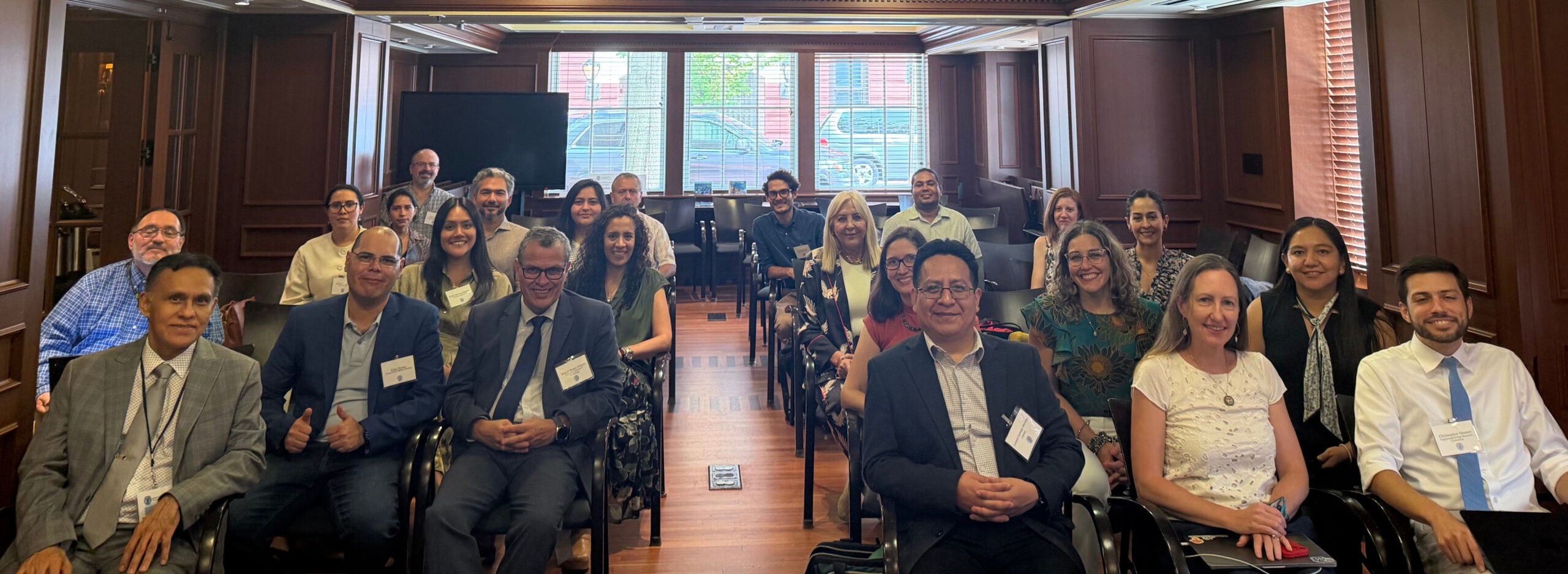
On September 10 and 11, Georgetown University’s STIA program brought together scientists, policymakers, government representatives and other experts for the Bioeconomy for Sustainable Development in Central America Workshop, a two-day discussion exploring how science, technology, and innovation can help advance sustainable development across Central America. Organized by STIA Professor Jorge Huete-Pérez, the workshop was generously supported by Schmidt Sciences, the Georgetown University School of Foreign Service, and the Mary and Felipe Rodríguez Education Fund.
The workshop built on an earlier 2023 gathering focused broadly on the role of science, technology, and innovation in Central American development. This year, organizers narrowed the conversation to biotechnology and the bioeconomy. The goal was to bring different sectors together to examine both the scientific possibilities and the policy conditions needed to translate innovation into regional development. In developing the program, organizers also received guidance from the U.S. National Academy of Sciences, including support in shaping the workshop and identifying potential speakers.
Across two days of lectures and panel discussions, the workshop moved from the broader scientific and technological foundations of the bioeconomy to examples of practical applications from the United States and Latin America. From there, the workshop narrowed its focus to Central America. Huete-Pérez explained that the goal was to draw on “all these experiences and good practices to consider what could be useful for Central America.”
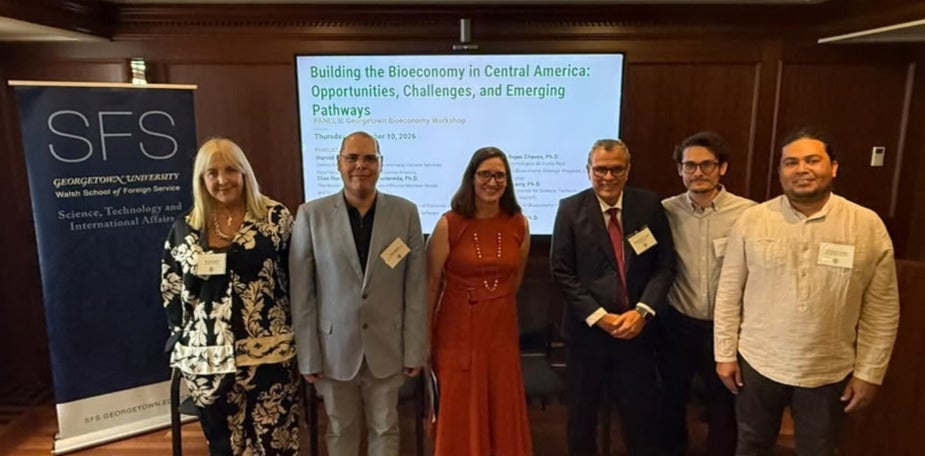
Panelists from Panel II: Central America: Opportunities, Challenges, and Emerging Pathways.
Huete-Pérez said the workshop was intentionally designed to bring together participants from across sectors, rather than scientists alone. Researchers were joined by policymakers, government representatives, and others, allowing scientific questions to be considered alongside the institutional and governance contexts that determine how new technologies are ultimately used. Huete-Pérez described it as a working forum in which participants could identify challenges, examine opportunities, and begin developing recommendations relevant to the region.
For Huete-Pérez, the intersection of science and policy was central to the workshop’s purpose. He emphasized the importance of thinking about science, technology, and innovation “beyond the lab” and considering “how that can be useful for science policy and governance in Central America.” For STIA students, he said, the workshop offered a clear example of bringing those scientific, technological, and policy worlds together.
The evening of September 10 also featured STIA’s 2026 Loewy Lecture in Technological Innovation and International Affairs, delivered by Dr. Edgar B. Cahoon of the University of Nebraska-Lincoln. This year’s lecture was uniquely incorporated into the broader two-day workshop, allowing Cahoon’s discussion of plant biotechnology and innovation to contribute directly to the workshop’s wider conversation on the bioeconomy and sustainable development in Central America.
“Georgetown is becoming a venue for a dialogue on Central American issues.”
Prof. Jorge Huete-Pérez
Seeing the Central America-focused workshop come to fruition was especially meaningful to Huete-Pérez. By convening scientists, policymakers, students, and other stakeholders around shared regional challenges, the workshop represented far more than a two-day discussion: it contributed to a broader effort to create space at Georgetown for sustained dialogue around science, innovation, and development in Central America.
“Georgetown is becoming a venue for a dialogue on Central American issues, and in particular, on the bioeconomy for Central America,” Professor Huete-Pérez said.