
Theresa and the MSFS STIA Connection – Bridging Science, Strategy and Global Leadership
As global challenges grow increasingly complex, the need for leaders who can navigate both foreign policy and scientific advancement has never been more urgent. At the intersection of these worlds is SFS Professor Theresa Sabonis-Helf, the inaugural chair of the STIA concentration within Georgetown’s Master of Science in Foreign Service (MSFS) program.
Launched in 2021, STIA is the first MSFS concentration to carry a STEM designation, marking a bold step toward equipping students with the technical fluency needed in today’s diplomacy. Under Sabonis-Helf’s leadership, the concentration now offers courses in energy and environmental security, innovation and emerging technologies and international science strategy. At its core is MSFS 505: Science Policy Matters—a gateway course Sabonis-Helf personally designed to challenge students to think critically about the ways science and technology are reshaping the global order.
Sabonis-Helf brings a rare blend of academic depth and on-the-ground policy experience. Before joining MSFS, she spent two decades at the National War College, where she was professor of national security strategy. She has advised the U.S. State Department and USAID, helped two post-Soviet states draft their first National Security Strategies and conducted fieldwork in seven former USSR countries. Her research spans energy security, regional water politics, climate governance, and electricity market reforms.
According to Sabonis-Helf, STIA attracts people who want to lead and solve problems, and she’s building a space where those people can thrive. Whether guiding students through questions of cyber policy or global climate diplomacy, Sabonis-Helf is forging a new generation of MSFS graduates fluent in the language of both strategy and science.
“That scientific mindset is essential—STIA graduates learn not only to question their assumptions, but to interrogate them,” she says. “I also expect each student to carry with them a specific skill that will help with analysis: something like renewable project design, data scraping, data analysis or computer modeling. In addition to that specific skill, I expect them to have enough mastery of an area of science/tech that they can engage in meaningful analysis and discussion with technical experts.”
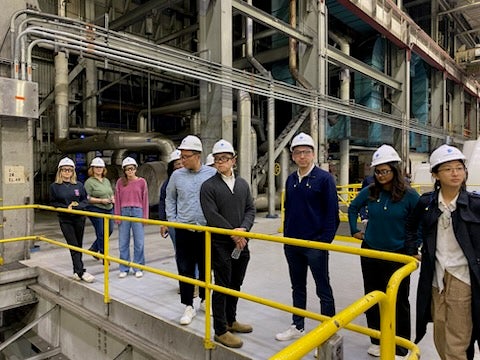
MSFS STIA students visiting a nuclear power plant.
As STIA grows, so does its influence across the SFS ecosystem, offering MSFS students not just a concentration, but also a mission: to lead with evidence, integrity, and global insight.